It almost
wasn't possible, but in the end, I did manage to travel to Odense to
attend
the events organized by the Museum of Photographic Art in that Danish
city
this past June 27 and 28, to accompany Viggo's photographic exhibition,
Ephëmeris.
I arrived in Odense early morning on Friday, having slept on the train
(as
far as one can call that "sleeping"), and since my hotel room wasn't
ready
yet, I went to walk around the pedestrian zone, hoping not to meet
anybody
because I hadn't even showered. I watched as shops were being opened
for
the day and later I sat at a nice café and had a couple of
cappuccinos.
Afterwards, I made my way to the museum. The bookshop was open by then,
so
I bought Viggo's new book, 45301,
returning to the hotel, where I leafed through it while the room
was being
cleaned. In the book, Viggo's photographs are placed over scans of his
writings,
pages from his journals, pieces of paper with random thoughts. Here the
adventure
started, when I saw a page written in Spanish and tried to make sense
of
what was written there, turning the book around, when I saw... the
rest,
I'd rather not share, suffice it to say that it was quite significant
and
pertains to something that happened later.
After - finally! - taking a shower and getting ready, I walked to the
café where we had arranged to meet the girls from The
House of Telcontar.
There I met Chrissie and her daughter, Majken and her very nice husband
and
Erika, a Japanese girl resident in Finland, who was representing
Hasemi,
the girl who writes the Japanese news page for HoT. I'd already met
Christine
and her friend Alex, but I was equally glad to see them again. We
talked
about many things, but the closer it got to the appointed hour we were
supposed
to go to the museum (5:30), the more the conversation was about
"Viggo".
We were nervous! When it was finally time, we walked the few feet to
the
museum doors. Inside, the very, very nice Tina and Susanne welcomed us
with
smiles on their faces and they gave us our tickets, they didn't even
ask
for id., it was like, ah, finally we put faces to the names. Viggo's
exhibition
was upstairs, so we waited there for about half an hour until they
opened
the doors and we were able to see the photographs. Let me tell you one
thing:
if I hadn't been able to see Viggo in person that weekend, seeing his
work
hanging from walls would have been enough. I've only seen it in books,
so
I already had certain favorites, but it's not the same, seeing them in
tiny
format on paper, than it is enjoying them in all their glory, framed,
big,
hanging from a proper wall.
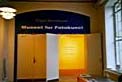
Immediately to the right of the door, the
first pleasant surprise: Ruth,
6:10 P.M. and Wolvenbosch were all in
that section. They're some of my favorites, Wolvenbosch is practically at the top of
the list, which is why I'd asked of him, some time ago, that he signed
that very page in Signlanguage.
The other two photos can be found in Recent
Forgeries (unfortunately, this book is out of print, and there
are no plans to reissue it). From there,
it got only better.
The photographs were arranged practically in chronological order, as I
was
told later, by Viggo's wish. So you could see very clearly how his
style,
technique and way og looking at things and life have evolved throughout
the
years. I don't mean they were arranged exactly according to date,
because
style, color and theme also influenced the decisions made when hanging
the
images. In any case, it's interesting to observe how in the most recent
photographs
Viggo shows as much interest in his subjects as in the variations and
techniques
he can use to create different visual effects. From these recent ones,
I liked Wild 13 the most.
It's a fascinating composition, in color: in the foreground, we see a
hand,
his, which seems to lift from the ground the life giving earth while in
the
background, seen against the light, a horse, barely discernible, almost
transparent,
blended with the light from the shining sun at his back. I liked
another
one that is in the Katalog, called Blue 4, which, as Lis
told
me, Viggo forgot to take along, as well as two others. It's not
surprising,
as busy as he seems to be. But let's leave a description of the
exhibition
to another page just for that purpose, coming soon.
I take this opportunity to tell you
about
Lis Steincke, the exhibition's curator, who got more work than she had
bargained
for if her artist had been less popular thanks to other
non-photographic
endeavors. Still, you might think she'd consider us a pest, but you'd
be wrong.
Lis always has a smile on her face and a kind word, no matter how
sticky
a situation may get.
And
sticky it got! A little after 7 PM Viggo arrived with his son Henry,
who's
already taller than he is and with Pilar, his partner in Perceval
Press.
He arrived from behind us, so you can imagine the public's reaction.
The
museum's director, Finn Thrane, was the first to address the captive
audience
(said audience was captive observing Viggo!). He spoke first in Danish
and
well, that was my handicap, I don't know any Danish. I can understand
somewhat,
(German, English and passive Dutch help), but fortunately, Mr. Thrane
repeated
his words in English, thanking Viggo, the museum's staff (specially
Susanne,
who later was made to come forward), Henry, who had very patient during
a
whole week of being ignored by busy people, and Pilar, who is - he
addressed
Viggo now - your right hand? The right side of your brain? Viggo
silently
responded by showing one hand first, then the other, and finally
lifting
the two! Viggo kissed both and posed for pictures with Henry. Because
even
though the press had already had a chance to photograph and interview
Viggo
before, there were about ten professional photographers, some of
whom
were quite rude, putting their cameras in front of Viggo's nose and
flashing.
Poor guy, it's a wonder he didn't keel over in a dead faint, eyes
turned
to spirals, like in a comic book! :)
Lis was next, she almost had to improvise
her speech
without her notes, which had gone missing. They were quickly found and
she
thanked not one son, but two: Henry, for having convinced his dad to
take
the role of Aragorn in the blink of an eye, and her own son, who
practically
dragged her to see The Two Towers, from which she
emerged delighted and curious to find out more about that guy with the
Danish name.
They surfed all night and at some point they found some of Viggo's
photographs.
So she endeavored to convince Mr. Thrane to invite Viggo for an
exhibition
at the MfF. The rest, as they say, is history.
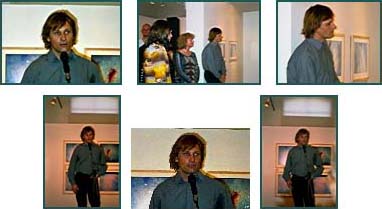
Now it was Viggo's turn. When he
got on the podium, we flashed him a million times, although it was
almost
not necessary to do it, it was so bright. He also spoke first in
Danish,
he thanked people and said something about Henry not having minded
being
ignored during the week, but I couldn't understand why, but he laughed
and
said he would repeat it in English. Turns out that he had been so busy
with
his computer all week, that he barely noticed. He thanked everybody at
the
museum, Pilar, and people who had come to see the exhibition, some from
far
away. I was standing almost at the front, so I could see him up close.
He
was sweating, not only because that day it was very hot, but also
because
the overhead lights were also quite hot. He gets a little nervous, it
seems
to me, changing the leg he leans on frequently and talking a lot with
his
hands in an almost "Latino" manner. A couple of times, looking at the
audience,
he happened to look at me with those blue eyes.
When
he finished, he made the mistake of placing himself in a corner of the
room,
which was not only small, but very hot due to the lights the many people who immediately surrounded him,
it must have been like an oven. I got a little closer, but abandoned
the idea of approaching him there, so I stood somewhere else with Erika
and the others, said hello to Pilar, who was very nice, even though she
must have had a very stressful time, and I chatted several times, here
and there, with Lis. I went around again with Erika, returning to some
of the photos, and this was very nice, because she knows about
photography
and we also talked about other photographers we knew and their work. At
some
point, I was talking to Lis and I felt that a lot of people walked
behind
me. Viggo had suddenly left that stifling corner and raced for the
terrace,
with a lot of people in tow. After quite a while, I noticed that there
weren't
as many people around him anymore, so I asked Erika if she was ready.
We
went outside and waited while Viggo attended to other people; almost
everybody
wanted an autograph on their invitation or items brought. You know
Viggo,
he has a kind word for everybody, he's very attentive. There were some
women
from the U.S. talking to him ahead of us, they asked him to sign
something
and gave him gifts, they were talking while to my left this huge guy
was
standing, maybe a relative, there was some resemblance, but fortunately
he
moved, or else, Erika and I would have been crushed :) I didn't feel
hot.
I wasn't sweating, my hands were dry, in hindsight, a very strange
occurrence,
because I'd always thought that I would be petrified, sweaty-handed and
blank-minded
in front of Viggo. Fortunately, that wasn't the case.
Suddenly I was facing him, so I said
"Hola,
Viggo", with a rather shaky voice. You should have seen his surprised
look,
probably the last thing he expected was to hear Spanish. I wasn't
nervous
all of a sudden. We shook hands and I introduced myself, and told him,
more
or less: "Congratulations, Viggo, on your exhibition and for having it
here
in Denmark". He thanked me and asked if I liked it. I said yes,
particularly
the way the photos were arranged, for the reasons I mentioned above,
that
you could see the evolution in style and technique, and we talked a
little
about that, he seemed to enjoy it. Then I told him I'd bought 45301
and that, even though I hadn't had time to take a careful look, I'd
leafed
through it and I'd noticed something on a certain page, so I asked if
it
was what I'd thought it was, and he said "yes". Again, I mention this
because
we talked a little about something related to it; we tried to remember
the
title of a certain book he'd read at university but we couldn't,
my
mind was a little blank after all, probably, because predictably I
remembered
all titles later. At that moment, I could only think of a single one. I
had
to repeat it because there was a lot of noise, I don't know why, but
anyway,
he leaned over to put his ear in front of my mouth, a very natural
movement,
surely, but would you believe it, I pulled slightly back. Don't ask me
why!
I guess I was nervous. Pilar came over, and since the
conversation
was in Spanish, I asked her if she understood. She said yes, and then
she
told Viggo that I did the Spanish news page for The House of Telcontar,
he wheeled around and said: "Oh, you
did that translation", referring to one I'd done, he congratulated me
and
said it was perfect :) He also gave his permission to use another
translation
as well, from his introduction in Un
hueco en el sol,
the booklet that accompanied his exhibition at the Fototeca de Cuba
last
May, even though he hadn't read that one yet. I was feeling really
proud,
as you can imagine! Pilar left, then. So, thinking I'd held him up long
enough already, I thanked
him again for bringing the exhibition to Denmark and told him it was
really
great to look at his work in this way. He started to shake my hand and
said
thank you and bye, I said "see you tomorrow", to which he responded:
"So
you're coming tomorrow?" "Sure", I said.
"I'll have to read something in Spanish, then", Viggo said. And
I, completely out of the blue, told him: "But please, not Chaco!"
You know, it's that poem that he "always" reads, about El Chaco
(also in Spanish,
here) in
Argentina, that begins with "I shit in the jungle..."
He laughed a lot (and you know how he looks when he laughs) and so did
I,
a little embarrassed for having told him that, but on the other hand
telling
him he always read the same one and it just would be nice if he read
something
else, just to change. He said something like "don't you like it? Is it
too
vulgar?", laughing, but I told him it wasn't that, it was the "always
the
same one" thing. I said that people hearing it for the first time did
think
it strange, "for instance, I showed it to my mother and she said 'what
is
this???'" As I was saying that, he was saying "How dirty" or "What a
pig"
(I think I saved the Mexican phrase in my head, but he couldn't have
said
it, "que puerco", what a pig, but that was the sense of the thing). I
repeated, no, no, no, no , no, "what is this"! So we
had a good laugh and who knows what he was thinking about this
woman,
telling him what not to read. I thanked him again and said good-bye
again,
we shook hands, again, and well, I got a little stiff, then, thinking,
should
I say good-bye with a kiss, which would have been the normal thing to
do
where I come from, but then I thought, maybe he doesn't want to, so I
stiffened,
shaking the hand. He also didn't move, but kept looking into my eyes,
making
me all the more nervous, because that's something he does, while he
talks
to you, he really listens, looks directly at you, the whole time. Gulp.
Erika was standing next to me and I almost
bumped into her. Viggo looked at her, but she didn't say anything. I
nudged
her and whispered "say something!" But she'd turned into a pillar of
salt!
I nudged her again, but then Viggo started talking to someone else.
When
he was finished, I told him to excuse me, but this was Erika, who was
from
Japan, but lived in Finland. He asked her if she spoke Finnish, and
Erika
croaked: "Yes". Then Viggo said: "Kiitos por tu
visita".
Hee, hee. Now
he was confused! "Kiitos" means thank you in Finnish, but Erika doesn't
speak
a word of Spanish! We went back inside and laughed about it, she asked
"What
did he say???" We waited for our friends from HoT, we talked to
other
people from the museum, one of the girls had spent some time in Mexico,
so
we talked a while, and then they close the doors, since they would
continue in petite comité, just family and
museum staff. As I was told later, they ate a marzipan cake that was
decorated
with the motive of one of Viggo's photographs, Cheyenne River 3.
Afterwards we went to have dinner and
exchange impressions.
I didn't want to go to bed, I asked a lot of people if they knew of a
place
that played Latin American music, but they didn't know (in my town,
there
is always something like that going on, every weekend). The others were
all
tired, so I went walking around Odense. The pedestrian zone was a
single,
big party! Everywhere you turned, there was some café or
restaurant
with people sitting outside, windows were open upstairs and music was
blaring
out, I almost felt like ringing some bell and coming up! Like I said, I
was
looking for salsa or something like that, because I don't mind going
there
alone, you always find someone to talk and dance with very quickly. I
also
thought, jazz, that I can also enjoy alone. But
the music was all pop or rock, and there were people clustering all
around,
and I would have felt weird and out of place. I did see other Viggo
fans
I'd spotted here and there, but, if you think we are all a big, happy
family,
you would be wrong. Apparently, people from different sites or message
boards
don't greet each other. Don't ask me why, since I don't really know
who's who. But well, at least I walked around
a lot, the evening was beautiful, and I felt really well. I finally
went
to the hotel and wrote down everything I could remember, because,
believe
it or not, you do forget the details.
The next day, Saturday, I got up late, not
caring
that breakfast at the hotel was served until ten, since the day before
I'd
noticed Odense had a lot of very nice street cafés where you can
have
breakfast, so I went out around 11. I walked around until I found a
very
nice café, Frank A, with tables outside. And
darn, Thursday evening
they'd had Latin American music. I ended up spending a good amount of
time
there, talking to table neighbors. Let me tell you that the Danes are
incredibly
nice and happy-go-lucky people, and something that is really noteworthy
is
that people look at you on the streets, they make eye contact, don't
pretend
to be studying some object several miles away. Felt very homey. I'd
been
to Denmark before, but not to Odense, even though I'd been to Egeskov
castle nearby. And I remembered two things from those times: how nice
the
Danes were, and how beautiful. So, the day was just so nice, I
thought to
myself, I don't want to spend it in a museum, sorry, even though Odense
has
several good ones. I'd rather walk around and observe people. Ended up
talking
to them, too, which was great, while having brunch and a delicious
double
cappuccino. And it was even better when all of a sudden I saw Viggo
walk
by, walking single file with Pilar in front and Henry behind, wearing
his
San Lorenzo T-shirt. Didn't see his feet, though! But I did think,
great,
he'll be wearing the football T-shirt to the poetry reading, "my girls"
will
be happy about that. The people I was talking to knew about Viggo's
visit
in Odense, although they'd never realized before that he did anything
else
but act, until they read about it in their local papers.
I didn't take any pictures, either, since I just wanted to take it all
in
as it was. A fact I regretted the next day when the sky became grey and
not
very picture friendly.
The poetry reading and book signing was to
take place at a small theater, Magasinet, a few steps
from the Museet
for Fotokunst.
At three, when I'd agreed to meet the girls, there was already a line,
rather, two, one from each side of the door. I thought it was going to
be chaotic when they opened, but I wasn't shocked, since in Mexico
nobody forms "lines" we form "bunches". Apparently, as I read
afterwards, so do the Danes :) And sure enough, there was a lot of
pushing and shoving, but some people were bothered by it. The "guys in
yellow", the very nice and well-mannered security men did their best to
maintain order. We went in, got our tickets from Tina and Susanne
again, we got these pieces of paper to put our names on to hasten
the proceedings when it was our turn to get (only two items) signed,
and
off we went.
We sat in the third row, pretty much in
the
center, and we didn't have to wait long. We noticed Pilar and Henry
coming
in and taking their seats - Henry was wearing a German Army jacket, I
wonder
if it was a fashion or socio-political statement :) Lis came out to
introduce
Viggo, but he also appeared and the flashlight deluge that followed had
Lis
saying: "Stop, stop, please! Now I know what Viggo means, you can't
even think with all this light!"
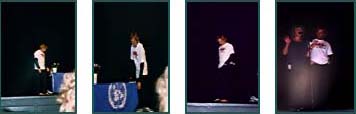
Meanwhile, Viggo was standing near the table where he was going to sit,
where
you could see a flower vase and his mate, and a plastic bag,
containing his
books and notes. He wasn't wearing the San Lorenzo T-shirt, but a black
long-sleeved
one, his "War is not the answer" tee over it, dark pants and no shoes
:)
He meticulously unfolded and hung a United Nations
flag at the front of the table, which prompted a round of applause. He then
approached Lis, and waited
for her to finish, to give her a flower he'd plucked from the
arrangement
on the table - with his teeth. Notice that white ghost in front of
Viggo
and Lis in the far right picture? Those were the flashes! We were told
not
to photograph during the reading, nor use any other kind of recording
equipment.
So we all frantically flashed away while we could :)
Viggo sat down and the mood
got
a bit more serious. He talked and read in Danish for a while, and, even
though
I managed to catch a few things here and there, it was obviously not
enough.
But I did try to write down which poems he read:
First he read from Nye
falsknerier
, the book that compiles Danish translations of some of his poems that
have previously appeared in Recent
Forgeries, Ten Last Night and Coincidence
of
Memory.
He said, in English, that he was going to read in Danish, since many of
those
present spoke it, even though others who had come from afar didn't, and
even
if they did, they would not understand his Danish. This in
typical
self-deprecating tone, alluding to some Danish journalists who have
written
they have trouble understanding him, which is absolutely ridiculous.
I'd
like to see them being fluent in so many languages! Still, he
seemed
to stumble on a word, and as I'd suspected and found out later, it was
the
very title of his book. But he laughed about it. He then proceeded to
thank
the translator of his book, Søren Vad Møller, whom he
asked
to take a bow, he was right in front of us. Viggo said that
Søren
had done the translations with some final input from him.
He read Beskæringer
first, which is the translation of Cuttings.
This I knew because we caught that he'd somewhat said "an errant vine
has
sprouted two blue flowers..." I just adore the English original. He
then
read Sten (Stones), at the end of which he
had to point out that it was over, which got a laugh from the audience.
He continued with Matiné, which was easy to
identify since the original is also called Matinee.
Before reading it,
he talked about going to the cinema and coming out of the theater with
the
impression that something had changed. Before he proceeded to read Brev
fra Nebraska (Letter from Nebraska), Viggo voiced
his opinion about the invasion and subsequent war in Iraq; for a
moment, he got quiet and probably was reflecting what to say, but then
he seemed to find the words and finish his criticism, which was
connected
to that poem, as he finished writing it shortly after the first US
invasion
of that country.
Viggo went on to talk about the Danish poet Viggo
Madsen and afterwards Majken, who does the Danish news page at the
HoT and has a Viggo page of her own, Danish
Articles,
commented that our Viggo
had wanted to read a poem by him, but he hadn't found any of his books
at
local bookstores, so he decided to read a piece by another Danish poet,
Søren Ulrik Thomsen
(see here
as well).
I'll tell you here that, all throughout the reading, Viggo fumbles and
searches
for the stuff he wants to read next, because as a rule, he doesn't
prepare
a rigid roster of what he's going to read; rather, he just picks
whatever
seems adequate for a specific moment. So he started explaining
something
about the next poem while leafing through his Danish book, but couldn't
find
it, so the translator told him where to find it. Then I caught that it
was Klipning, translation of Edit, which he proceeded to read. I think that, for the first time, he drank from his mate then (pronounced mah-teh), which he
sipped in the traditional way, from a bombilla, a funny-looking
cup shaped like a sphere with a long straw. But apparently, it
wasn't cebado, a process which requires the bombilla to
be constantly refilled with a little hot water (¡Gracias, LK!).
So, was he drinking it cold? He continued with Frokost (Lunch),
which is a favorite of mine, specially the way he reads it in the "His"
and "Hers" versions in the CD One Less
Thing To Worry About. He then explained something about a factory
and something about metal, and read Bly (Lead).
So it's no wonder that he was talking about metals, since that poem is
about
factory workers. Before he finished reading in Danish, he included a
poem
by another compatriot, Lone Munksgård
Nielsen.
Viggo took a sheet of paper in his hand and
explained
something in Danish first, but switched to English: I had the
impression
he wanted to make the event a little bit more serious with these
comments,
even though he sometimes joked. He said that it was always better to
just
read a poem without explaining anything, as somebody had told him once
that,
if a poem needed explaining, there was something wrong with it. "And
I'm
sure this one is wrong", he joked, but then got serious again. And let
me
tell you, there is nothing wrong with this poem, on the contrary, it
packs
a great emotional punch. He mentioned the
invasion
of Iraq again, the fact that people should always be aware that they
had
a voice and that this voice could be raised, and he focused in the
human
aspect of the situation, the suffering and the pain of those people in
that
far away country, seen only through news reports, while we kept going
on
with our lives. As you can imagine, he read Back
to Babylon, the
poem he wrote last February and which deals precisely with that
suffering
and the fact that the majority of the people in the US opted to ignore
what
was really happening there and go on with business as usual, putting on
blinds
and seeing only what wasn't too uncomfortable for them to see.
You can probably picture the mood right then. And
then something extraordinary happened, but that deserves an extra page!